Types of Industrial Blades and Machine Knives according to their Different Shape or Application
Choosing the right cutting tool can sometimes seem like a daunting task, so if you want to learn more about where to get the best industrial blade for your cutting tools and equipment, you've come to the right page. This text describes in detail different machine knives and industrial blades suitable to be mounted in machines for cutting applications.
_________________________
Introduction to Industrial knives and blades
Machine knives, or industrial knives, are used in manufacturing to cut and slit various materials. People have been making knives since Stone Age. Over time improved materials made knives better and more durable.
With industrialization in the early 19th century, knives and cutting tools began to be used in the manufacturing industry. Today, the variety of cutting tools and knives is determined by the development and needs of global industrial production, depending on a vast array of material to cut. The most common materials for cutting with industrial knives and blades are: paper, cardboard, tape, polyester, plastics, plastic film and foil, foam, felt, rubber and metal foil.
Sollex designs, optimize and make knives for industrial applications with the toughest requirements on product and material quality. We are the leading supplier of industrial knives and blades in Sweden. Our customers are industrial manufactures in plastics, food, paper and packaging. There are many blades with different shapes and sharpening, knife blades with different grinding and hole patterns.
Industrial knives are used for:
- for cutting plastic film, foil, plastic packaging
- production of paper, cardboard, paper products
- rubber and rubber goods cutting
- plastic processing,
- pelletizing,
- light industry
- food industry
- production of pharmaceuticals and medical equipment
- production of advertising materials and printing products and much more
Types of Industrial Blades and Machine Knives according to their Different Shape or Application
1. Industrial machine knives
1.1. Circular Knives
The circular knife is a popular and versatile tool for industrial application. It is mainly needed for sharpening and cutting various materials, regardless of their flexibility and hardness.
Areas of application of circular knives:
- Metal cutting
- Paper and tissue industries
- Process industry
- Printing industry and typography
- Food and light industry.
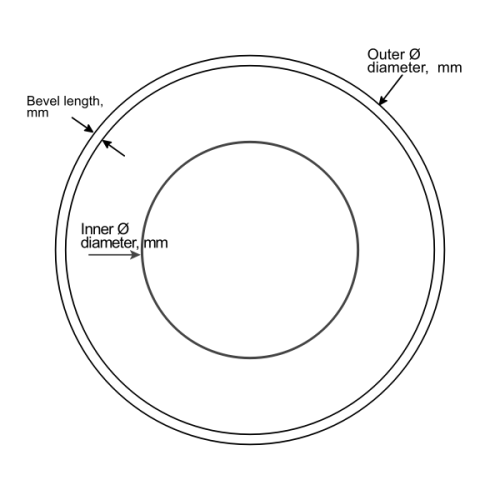
Typical metal circular blades have a circular shape and a hole in the center, necessary for a firm grip during cutting. The thickness of the working blade is selected depending on the materials to be cut, but it is usually about 10 millimeters. The main characteristics of a circular knife are the outer diameter (the size of the knife from one edge to the opposite edge through the center), the inner diameter (the diameter of the central hole intended for attachment to the holder), the thickness of the knife, bevel and the angle of bevel.
A circular knife has an inner diameter connected to a machine shaft or holder and an outer diameter with a cutting edge designed to cut a specific material. Produced in different materials and properly adjusted, a circular knife is a durable and robust machine knife design. Compared to razor blades, circular knives have longer durability but a less clean cut and generate more dust.
Circular knives are usually used to cut plastic foam, adhesive tape, non-woven, rubber, paper, cardboard, paperboard, labels, insulation materials, cable, circular knives for cutting foil and film. Sollex circular knives can cut through plastic film, carpets, rubber, paper and much more.
1.1. Circular Slitter Blades
Circular slitter blades or circular slitting knives are knives with sharp cutting edges, low cutting angle and no teeth. As the name suggests, circular slitter blades are mostly used for slitting type cutting operations. The score cut slitter knife is commonly used for crush cutting paper, film and foil products as well as non-woven products. Slitter knives consist of a top slitter blade and bottom slitter blade used for machinery cutting processing.
1.2. Top slitter knives (Dished knives)
Top slitter knives are also called Dished knives as they have a shape of a dished plate. Top slitter knives or dished knives are used for cutting film, paper and in the processing industry.
Top and bottom knives work in pairs as the top knife regrinds when in contact with the bottom knife. Top knives are used for cutting material webs and give a really long lasting durability. Dished knives are relatively easy to regrind.
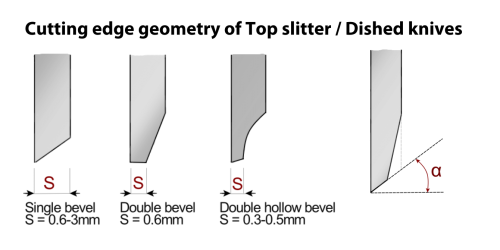
The top slitter blade can be dish shaped or flat shaped with single, double bevel (edge) or square edged. For the score cutting, there is only one blade that works as the roll or sleeve stand as the bottom blade. Besides some of our customers also called top slitter blades as male or front blades.
The cutting edge of these tools is very diverse and depends on the type of material being cut. It can have a single-sided blade, with a ground back or double-sided blade, etc.
- Single bevel S = 0.6-3mm
Fields of application: hard materials for ex cardboard, thick plastic-/ aluminum foils
- Double bevel S = 0.5mm
Fields of application: paper, light cardboard, textiles, nonwoven, tissue
- Double hollow bevel S = 0.3 - 0.5mm
Fields of application: thin paper, thin plastic-/ aluminum foils, labels, multilayer paper
Cutting bevel - angle of bevel and material to cut:
- α = 0-10° - metals, laminates, plastics
- α = 30° - paper, foils, laminates, fleece, cardboard, nonwoven, tissue
- α = 45/ 60° - special application, film industry, multilayer paper
1.3. Bottom Knives
Bottom knives are used in pairs with Top knives (dished knives). By definition the bottom knife is located on the lower shaft compared to the to knife. There are some variations of bottom knivfe types: multi groove bottom slitters, single and double edge bottom slitters, square edge cutters, solid or tipped carbide bottom knives and cutters etc. It Is also possible to have multiple bottom knives on one knife.
The main principle for a bottom knife is to position the material web and stretch it for the top knife to cut it. In addition, the bottom knife should “regrind” the top knife when it comes in contact with the top knife. Therefore it is absolute imperative that the bottom knife is angled correctly. Without a paper angled bottom knife the knife pair will not perform satisfactory.
1.4. Perforator Crush Cutter
The principle for crush cutting is using a rather blunt knife (Crush cutter) for cutting a material web by pressuring it against a glass hard shaft. Crush cutters is a simple method easy to handle. Crush cutters work well for perforating and profile cuts of material web. Crush cutters are used for thick materials in plastic, rubber, labels and adhesive tapes, textiles and non woven.
Important factors to consider when choosing a crush cutter:
- diameter of crush cutter
- radius and cutting angle
- material to cut
One version of the crush cutter is to have a perforated edge. This gives the cut material a perforated cut. Dependent on how many teeth the perforated crush cutter has you can design the finished material perforation. There are two forms to design a perforated cut: straight line and wave form or zig-zag-pattern.
By definition the perforated crush cutter cuts small holes in the material web. Combined these hole make a perforation. Perforated cuts can be used in a vast array of applications. One daily usage of perforated cuts is small plastic bags put together on a roll. To remove one you simple tear the perforation done by the crush cutter knife.
1.5. Toothed / Serrated knives
Toothed blades are defined by having a toothed cutting edge. These types of blades are used for perforation in the cutting materials and cutting materials with many entrance points.
Some examples of teeth are V cut profile, serrated, perforating, and scalloped edge. Toothed blades have different lengths of teeth and different widths between them. Toothed blades are used in different industries such as packaging, rubber converting, tire, food processing, paper cutting and many others. Toothed blades are also suitable for cutting tapes.
We stock some serrated blades but manufacture most serrated knife blades to drawing and customer requirements. Serrated blades or perf knives can also be used to cut thin non-woven material.
Serrated knives have a toothed or saw-like edge grinding. Serrated knives have different tooth lengths and different teeth widths. Serrated knives are used with a back-and-forth motion. Optimized for cutting fabrics, belts and ropes, and other textured materials. Serrated blades also perform well on soft and flexible materials. You can also use serrated blades or perforated knives to cut thin nonwoven material.
The disadvantage of serrated blades is fraying and when the blade dulls it is very hard to sharpen. That work is mainly done bye hand and is relatively time consuming because sharpening must occur between each tooth.
In addition serrated blade cuts are less clean compared to cuts by a straight edged knife. A successful serrated knife is a combination of the right angle of the point and the distance between the teeth.
A scalloped blade is similar to a serrated and toothed blade but the design is more scalloped. This industrial blade type is seldom used as the scalloped tip of the blade is fragile and hard to handle.
Industrial saw knives are used for cutting hard materials such as wood. Saw knives have specific teeth designs optimized for each material to be cut. Primary usage for saw knives is to cut wood.
2. Industrial Razor Blades
An industrial razor blade is defined by its thin thickness and sharp grinding. This gives Razor blades its cutting characteristics, clean cut, and the least amount of dust. The beauty of the razor blade is its simple design and efficient cutting performance. There are many types and versions of razor blades used in machines all over the world. Three general types of razor blades are used: Three hole razor blades, slotted slitter blades, and injector blades.
2.1. Three hole razor blades (straight or rounded corners)
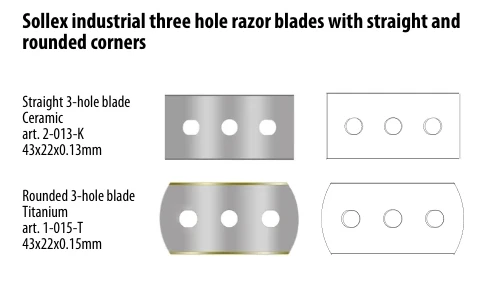
The three hole (3-hole) razor blade is the essence or definition of a razor blade. Initially it was developed with round corners for easier and safer shaving. The user could hold the blade in the rounded sides without touching the edge. When three hole blades was abandoned for shaving in the 1930ies it was quickly replaced by straight three hole blades for industrial usage.
In an industrial perspective a straight three hole blade generates less waste when produced and gives better cutting performance due to less stress in the steel.
Most three hole blades are 43mm long and 22mm wide. They are available in a vast number of thicknesses: 0.06mm, 0.08mm, 0.10mm, 0.13mm, 0.15mm, 0.20mm, 0.28mm, 0.30mm, 0.40mm.
Three hole razor blades are made in stainless steel, carbon steel, steel with coatings, solid tungsten carbide, and ceramics. They are used to cut many different materials such as: plastic film, plastic foil, aluminium, tape, non woven, and paper products.
2.2. Slotted slitter blades
Slitter blades or Slotted slitter blades are used in many different machines for slitting materials. Initially its a blade used by American craftsmen. Refined and developed the Slotted blade is used in Slitter sheeter, rewinders, and other web slitting applications. The blades are also used for converting paper, slitting film, tapes, and construction materials.
The slotted slitter blade is the ultimate blade for flexible packaging materials and plastic bags. In general there are three different qualities of Slotted slitter blades. Stainless steel, coated and different hard metals and ceramics. In general the slotted slitter blades are made in 0,40mm and 0,2mm thicknesses. Durability and performance is very dependent on the material that is cut.
2.3. Injector blades
Injector blades are small razor blades, which are ideal for heavy industrial use. Injector blades were originally developed as razor blades for shaving. The Gillette blade was big and clumsy and the design of the injector blade made it easy to fit in a handle. The blade has one single edge. Today injector blades are mostly used for industrial purposes. The size of the blade is pretty tiny: 38x8x0.25mm or 1.496”x0.315”x 0.01”. That means that the injector razor blade can be fitted in really small areas of your machines. Today injector blades are placed in products but many users cut plastic film and foil with Injector blades.
2.4. Trapezoid blades or Trapez knives
A Trapezoid blade or a trapez knife is by definition a blade with its base longer than its top. A typical Trapezoidal blade is a one edge blade where the grinded edge is longer than the non grinded back of the blade. This is probably the most common blade in the world found in numerous box cutters and hand held knives all over the world. This trapezoidal blades are made by grinding a steel coil with one edge and leaving the back non grinded. Trapez is a German short name for Trapezoidal blades. Customers who buy our custom trapezoidal blades include world leaders in the automotive and food industries.
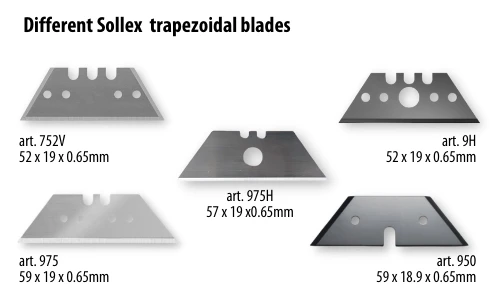
However, there are other versions of this blade type. A good example of a Trapezoidal knife blade with a different grinding is the Martor 614 blade, which is no longer produced by that company, but Sollex produces the 950 blade, which is exactly the same blade in the same steel. The blade is unusual in that it is sharpened on two short sides. Thus, the blade of the Martor 614 knife has two edges, but is only sharpened with a one-sided double-bevel grinding. We have previously described the Martor 614 knife blade as a knife blade with a long straight edge on the sides of the u-sharpener. The Martor 614 knife blade, or as we at Sollex call it 950, is used to cut leftover plastic horizontally when, for example, two coils of plastic film are joined.
2.5. Pointed blades
Sharpened pointed blades are most often irregularly shaped, with one or more ends sharpened to be used in industrial machines. The shape of this type of machine knife determines its application area, namely not deep cutting off material, but surface and precise cutting.
The cost of a pointed tip blade is incrementally higher than a blade having a simple straight edge shape. The reason is that a pointed blade is much harder to grind compared with a blade that easily can be grinded on a steel coil.
Sollex pointed blades have many different applications. The high quality steel in the pointed blades makes them especially suitable for challenging work. If you need to cut materials such as hose or cardboard, we have many different models to choose from. Some blades are coated with a ceramic coating, which considerably extends the durability of the tip blade. The edge coating acts as a protection for wear and tear. We also manufacture pointed tip blades in solid tungsten carbide with extreme performance and durability.
2.6. Granulator Knives & Pelletizer Blades
The definition of a granulating knife is a 3-5mm thick knife which mill leftover materials to be recycled. When recycling plastics the first step is to grind down the material. For this grinding process Granulating knives grind the material to a pulp. When doing so it is important have not too hard knives as they will easily break off small pieces or tips off the edge when granulating plastic materials for recycling. The granulator knives moves against each other which makes it important to have exactly dimensioned knives.
A Pelletizer blade is a blade designed for recycling plastic left-overs and cut it into new pellets. After granulating the recycled material it is heated to become a paste. The paste is pushed though fine pipes or tubes and when leaving the pipe a Pelletizer blade cut down the paste into small pellets. The pellet blade is tensed to the plane (by end of the pipe or tube) to cut or plane the pellets into perfection. Hence the special design of the pelletizer blade. The design is made to have flexibility in the blade so the cut is smooth along the end of the tube. There are pellet blades of various dimensions and qualities with many designs are available with different cutting angles and hardness of the steel.
2.7. Long knife blades
Blades that are thicker than 1mm we generally name knives. Long knife blades are typically found in machines cutting long materials. It is possible to make knives that are more than 3 meters long. We use the name long knife blades for long blades that are thicker than one millimeter and longer that 150 millimeter.
2.8. Other industrial blades
Our range of special knives and machine knives includes a variety of shapes, grinds, steels and hardenings. Drawing on Scandinavian quality standards, we have developed a unique range of trapezoidal blades and individually sharpened knives that are suitable for many applications and cutting processes.
In addition to our wide range of knife blades and additional blades for safety knives, we offer trapezoidal knife blades with a unique design, lateral sharpening, special sharpening and hole pattern. Our company's particular strength is in knives used in the production of plastic film, plastic and packaging.
Coatings of industrial machine knives for better performance
Steel quality defines how well a knife performs. Coatings on the blade can be used to change the characteristics of the cutting application. The edge coating on the blades acts as a protecter against the wear and tear of the material.
Quality stainless steel blades are applicable for slitting different substrates such as PVC, PET, LLPDE, HDPE, PP, shrink film, stretched film, overwrap etc. Coated industrial blades change the cutting properties of the blade. This makes coated blades ideal for heavy industrial use. With coatings we protect the blade from abrasion, to reduce friction, and increase performance and durability. If you have to cut materials with glue and dirt, coatings can be used to reduce glue and dirt sticking to the blade.
Common materials used for coating blades are titanium (-T), ceramic (-K), zero friction (-Z) and tungsten carbide (-V). Sollex ceramic-coated blades are FDA and EC approved, which means that they can come into contact with food.
If you are going to cut thin stretched film ( ex. LLDPE) with an automatic or semi-automatic wrapper, our Z-coating is perfect. For white plastic film (Poly film with additive chalk), Blades with K-coatings are a wise choice.
Machine knives and blades for Industrial applications to order
Using the right industrial knives brings prosperity, peace of mind, and a better end product. By combining different sizes, designs and materials, you can achieve the cutting performance you need. If you need inspiration, we recommend that you download our short catalog with the best selection of knives and blades for industry.
All the machine knives we offer are used by previous customers. If you didn't find what you were looking for, it's good to know that Sollex is a reliable European manufacturer of industrial blades. We will manufacture the right special knife to your drawing, part number or sample. If you would like us to visit your facility, let us know and we will be happy to come to you. If you have any questions about machine tool knives, contact Sollex at +4635-15 75 00 or by email order@sollex.se.


Comments
Post a Comment